Research
Memo Honey Research: Is There a Study or Clinical Proof?
No published study of Memo Honey exists in our sources, so it cannot be called clinically proven. Its ingredients were studied one by one, mostly for exercise at gram doses, while one capsule holds milligrams. Mayo Clinic lists no memory use for arginine. The memory claim is the seller's wording, not a tested result.
Written by the MemoHoney editorial teamMedically reviewed by Dr. Mary Cunningham, NeuropsychologistPublished Last updated · 8 min read
Short answer
Is there a published study of Memo Honey?
Not in any source we have. According to those sources, no trial of the MemoHoney formula had been published by October 15, 2026, at any dose or for any length of time.
That includes searches that add a year to the name. A phrase such as memohoney research 2026 is a search term. It is not a study. Pages that use it to rank are not research. A page that sells MemoHoney is not an independent source either, and that includes ours. We earn money when you order through our links.
- No published trial of the finished capsule.
- The sales page makes brain and blood flow claims. Our sources do not back them at the capsule's amounts.
- The ingredient research is mostly about exercise, at 2-20 g, 3-8 g and 1.6-6.4 g a day.
- NCCIH: direct evidence that supplements prevent Alzheimer's or other dementias is lacking (NCCIH, Supplements for cognition).
Ingredient research
What research exists on the ingredients?
Some, and it is worth reading carefully. Each ingredient was studied alone, for a different purpose.
| Ingredient | Studied for | Studied dose | In one capsule |
|---|---|---|---|
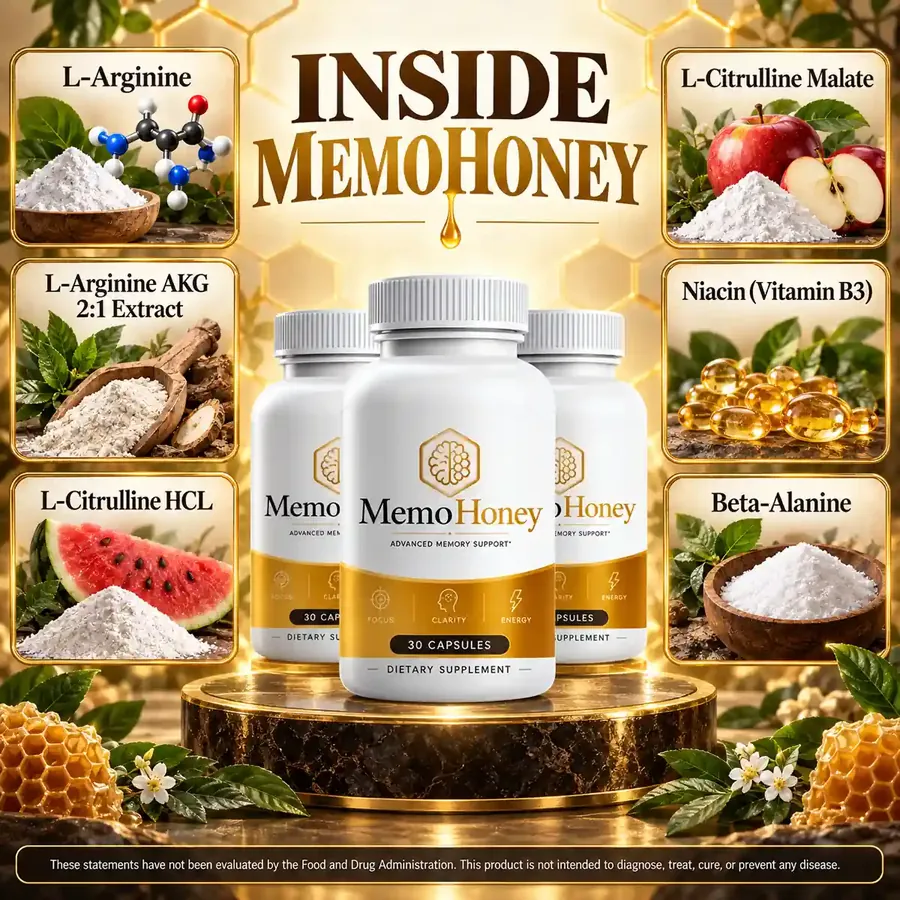
| L-arginine | Exercise; heart, blood pressure and circulation (Mayo). No memory use listed | 2-20 g a day | 400 mg (two forms) |
| L-citrulline | Exercise; weak support | 3-8 g | 200 mg (two forms) |
| Citrulline malate | One weightlifting study | 8 g | 100 mg of the 200 |
| Beta-alanine | High-intensity exercise; mixed results | 1.6-6.4 g a day for up to 8 weeks | 40 mg |
| Niacin | A needed nutrient; memory only in severe deficiency | Daily Value 16 mg NE | 7.5 mg NE (47% DV) |
| Calcium | A trace in this capsule | Daily Value 1,300 mg | 18 mg (1.5% DV) |
Sources: (NIH ODS, Exercise supplements) (Mayo Clinic, L-arginine) (NIH ODS, Niacin). One capsule gives about one-fifth of the lowest studied arginine dose, one-fifteenth of the citrulline and one-fortieth of the beta-alanine.
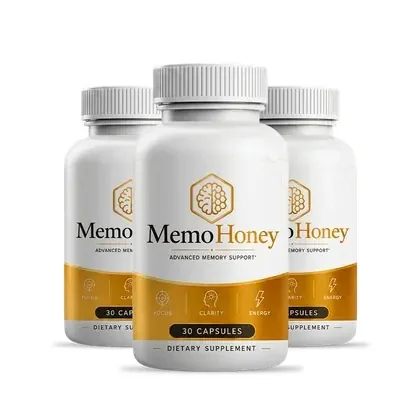
Research can wait for your questions, and the label cannot. The sales page shows both the bottle and the terms.Disclosure: this site is paid when an order goes through its links. Price and terms are set on the sales page.
See today's price and guaranteeThe theory
How is Memo Honey supposed to work, and does research support each step?
The sales page idea runs in four steps. Arginine and citrulline go in. The body makes nitric oxide. Nitric oxide widens blood vessels. More blood reaches the brain. Here is each step against the sources.
| Step | What the sources report |
|---|---|
| The body makes nitric oxide from arginine | True as chemistry. Citrulline enters the same path because the body turns it into arginine |
| More arginine means more nitric oxide | At 2-20 g daily the usual finding was no change in nitric oxide (NIH ODS, Exercise supplements) |
| More nitric oxide means more blood flow | Those studies typically saw no change in blood flow, and they looked at muscles, not the brain |
| More blood flow means better memory | Not shown. No memory use is listed for arginine (Mayo Clinic, L-arginine) |
| The MemoHoney capsule does all this | Not studied |
If grams did not shift nitric oxide, a few hundred milligrams is unlikely to. That is an inference, not a finding. It is why we call the claim untested rather than false.
What proof needs
What would clinically proven actually require?
Words like clinically proven are not a standard on a label. Health claims need competent and reliable scientific evidence, and testimonials cannot take its place (FTC, Health claims). For a memory supplement, that would reasonably mean:
- A test of the finished product, not only of single ingredients.
- A test in people, not in animals or in a lab dish.
- A measure of memory itself, not of exercise or blood flow.
- The same amounts as in the capsule.
- A report that others can read, with a named lab, a named team and a date.
MemoHoney meets none of those today. We do not say that to scare you. We say it because the words proven and clinical are easy to print and hard to earn.
Reading claims
How should you read words like clinically proven on any memory supplement?
Ask four short questions of any bottle or page.
Proven by whom?
A named lab or study you can look up, not a badge or a logo.
Proven in what?
The finished product, or one ingredient at a different dose?
Proven for what?
Memory, or exercise performance and blood flow?
Proven when?
A date and a source. A hot new year in a title is not a date.
NCCIH notes that ginkgo, omega-3s, vitamin E, curcumin and B vitamins have not clearly helped in studies (NCCIH, Supplements for cognition). The same agency says not to use a supplement as a reason to delay a provider visit about memory loss. In 2019 the FTC and FDA warned sellers over Alzheimer's and dementia claims (FTC, Alzheimer's claims letters).
Practical
What can you do with this if you still want to try it?
Use the gap as a reason to run a careful test, not as a reason to expect a result.
- Write down a baseline week before the first capsule.
- Take one capsule a day, as the label says, and log weekly.
- Review at day 30 and decide before day 60, inside the money-back window.
- Show the label to a pharmacist if you take any medicine that arginine can affect.
- See a doctor first if memory loss disrupts your daily life.
The label carries the standard FDA statement: the product is not intended to diagnose, treat, cure or prevent any disease. It is not FDA approved, and no supplement can be (FDA, Supplement Q&A).
FAQ
Frequently asked questions
Is there a Memo Honey clinical trial?
No published trial of the MemoHoney formula exists in our sources. Its claims rest on its ingredients, which were studied alone, mostly for exercise and at doses many times higher than one capsule.
Is Memo Honey clinically proven?
No. Nothing we can find supports that wording for this capsule. Clinically proven would need a test of the finished product, in people, measuring memory. None has been published.
Do arginine and citrulline help memory?
Our sources list no memory use for them. They were studied mainly for exercise and blood flow, at grams a day. Mayo Clinic lists heart, blood pressure and circulation uses for arginine, and no memory use.
How does Memo Honey work?
The sales page says arginine and citrulline feed nitric oxide and raise blood flow to the brain. That is a theory. In exercise studies, grams of arginine typically did not raise nitric oxide or blood flow.
Is Memo Honey effective?
There is no evidence either way for the finished capsule, because it has not been tested. The niacin helps mainly if your diet is short of it. Judge it by your own weekly log.
Are there scientifically proven brain supplements?
NCCIH says direct evidence is lacking that supplements prevent Alzheimer's or other dementias, and that ginkgo, omega-3s, vitamin E, curcumin and B vitamins have not clearly helped. Check any claim of proof against a named study.
Verdict
Our view
The honest research summary fits in one line: the ingredients are real, the studies were about something else and the capsule itself has not been tested. That is not a scandal. It is simply where the evidence stands.
We think readers deserve to see that gap, because the sales page speaks with more confidence than the sources do. We also think it is fair to say what is solid: a printed label, a named distributor and a written refund route.
If a trial appears, we will read it and update this page. Until then, treat MemoHoney as an untested daily habit. And if forgetfulness is getting in the way of your life, a doctor can look for causes that no supplement can.
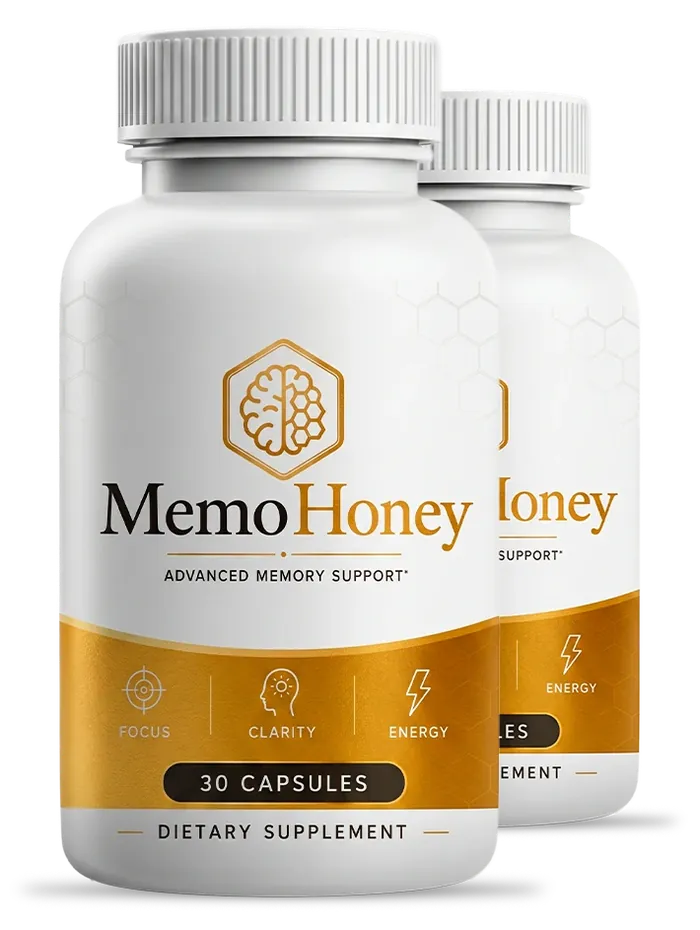
If you try the capsule, treat it as your own small test and use the 60-day window printed on the sales page.Disclosure: this site is paid when an order goes through its links. Price and terms are set on the sales page.
See today's price and guarantee