The formula idea
How MemoHoney Works: Nitric Oxide and Brain Blood Flow
MemoHoney is meant to work through nitric oxide.
The sales page says its arginine and citrulline feed nitric oxide and raise blood flow to the brain. The body does use arginine to make nitric oxide, and the NIH sums up the exercise research on it (NIH ODS, Exercise supplements).
Written by the MemoHoney editorial teamUpdated
The pitch
How is MemoHoney supposed to work?
According to the sales page, through blood flow. It presents arginine and citrulline as building blocks for nitric oxide, which it links to better circulation in the brain.
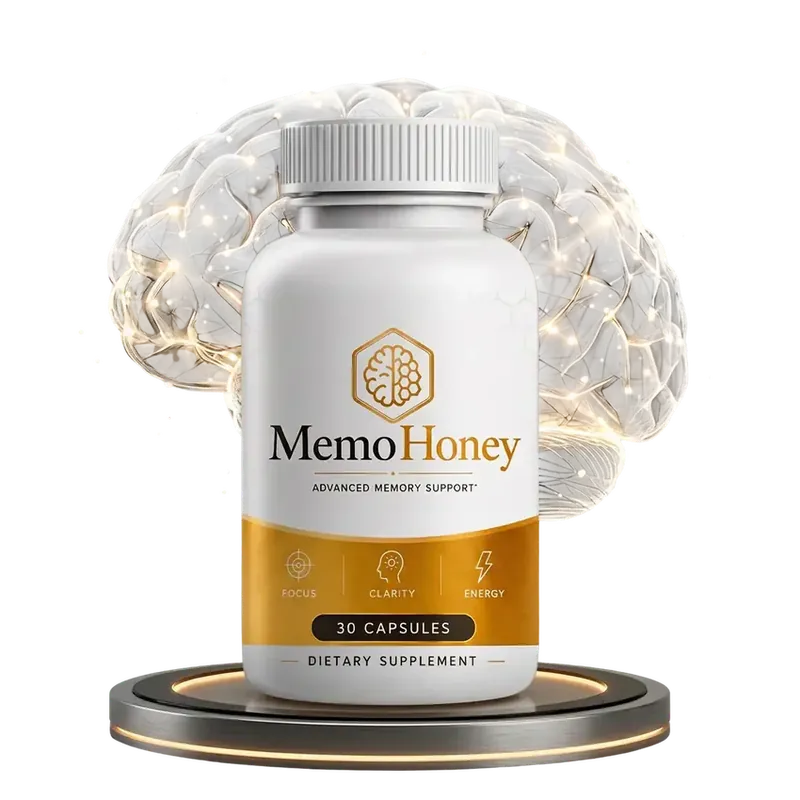
The sales page says MemoHoney can "increase cerebral blood flow" and support memory, focus and brain health (MemoHoney sales page). The label itself makes one short claim: "Advanced Memory Support*".
The idea runs in three steps. Arginine and citrulline go in. The body turns them into nitric oxide. Nitric oxide widens blood vessels, and more blood reaches the brain. Each step sounds reasonable on its own. The question is whether the doses in one capsule move that chain at all.
These are the brand's claims, not findings. The asterisk on the label leads to the FDA statement: not intended to diagnose, treat, cure or prevent any disease.
Body chemistry
What does nitric oxide do in the body?
Nitric oxide is a gas the body makes in small amounts. One of its jobs is to signal blood vessel walls to relax and widen.
Your body makes nitric oxide from arginine. Citrulline enters the same path, because the body can turn it into arginine. That is the chemistry the sales page leans on.
Citrulline
An amino acid the body converts into arginine.
Arginine
An amino acid that enzymes split to release nitric oxide.
Nitric oxide
A short-lived signal that tells blood vessels to relax.
None of this is in doubt. What is in doubt is whether swallowing a little more arginine or citrulline changes how much nitric oxide you make. The body already gets arginine from food and makes some of its own. Read more on the L-arginine and L-citrulline pages.
What research found
Do arginine and citrulline raise nitric oxide or brain blood flow?
Not reliably, based on the human research the NIH reviewed. Gram doses of arginine typically had no effect on nitric oxide or blood flow (NIH ODS, Exercise supplements).
| Step in the idea | What sources report | Source |
|---|---|---|
| Arginine raises nitric oxide | At 2 to 20 g a day, typically no change in nitric oxide concentration | (NIH ODS, Exercise supplements) |
| More nitric oxide means more blood flow | The same studies typically found no change in blood flow | (NIH ODS, Exercise supplements) |
| Citrulline adds to the effect | Studied at 3 to 8 g; research does not provide strong support | (NIH ODS, Exercise supplements) |
| Arginine helps memory | No memory or brain use listed among its studied uses | (Mayo Clinic, L-arginine) |
| The MemoHoney formula works | Not studied | No published trial |
These studies were about exercise, so they measured blood flow to muscles, not the brain. Even so, they are the best human data on these doses. If grams did not shift nitric oxide, a few hundred milligrams is unlikely to.
Want the longer version? Read what research shows on nitric oxide ingredients and memory.
Dose check
How much is in one MemoHoney capsule compared with studies?
A small share. Arginine is about one-fifth of the lowest dose studied, citrulline about one-fifteenth and beta-alanine one-fortieth.
Each ingredient's part
What role does each MemoHoney ingredient play?
Arginine and citrulline carry the blood-flow idea. Beta-alanine and niacin come from different worlds: sports nutrition and basic vitamins.
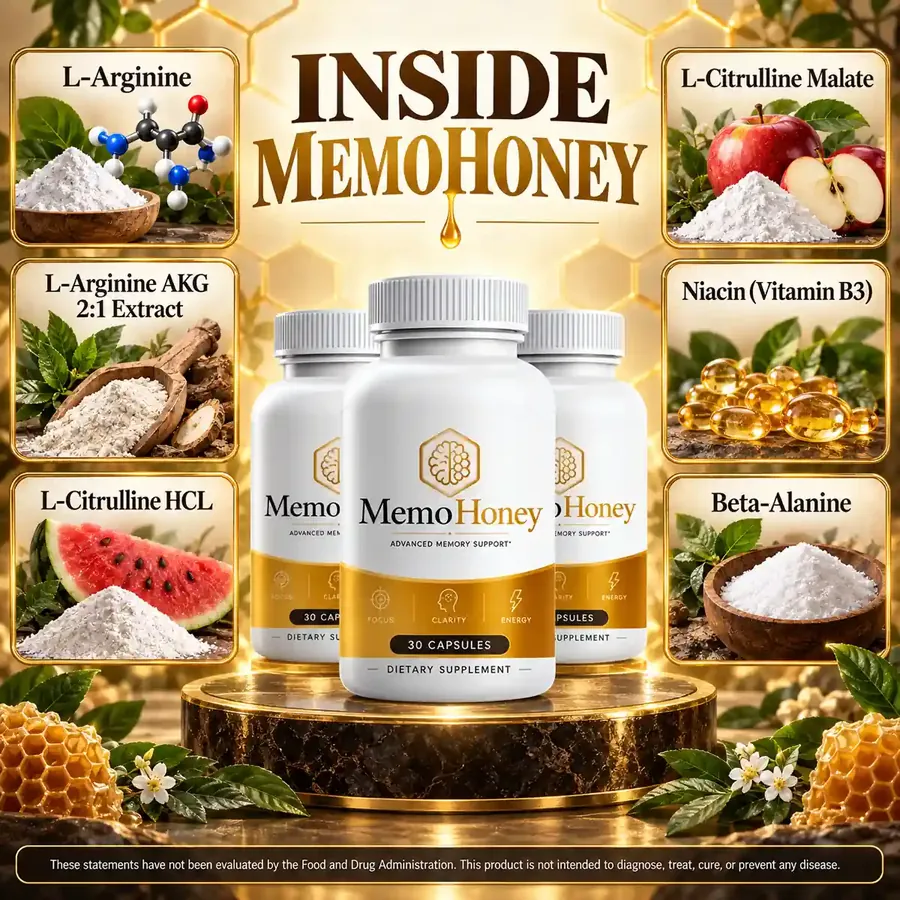
L-arginine, 400 mg
Two forms, base and AKG. The direct starting material for nitric oxide. Also the ingredient with the most medicine cautions.
L-citrulline, 200 mg
Two forms, HCl and malate. Turned into arginine by the body, so it feeds the same path.
Beta-alanine, 40 mg
Helps muscles build carnosine for hard exercise. The label gives no memory role for it. Details.
Niacin, 7.5 mg NE
Vitamin B3 at 47% of the Daily Value. Matters for memory only when someone is deficient (NIH ODS, Niacin). Details.
Calcium appears at 18 mg, a trace with no stated role. The capsule is hypromellose, a plant-based shell.
Ready to try MemoHoney?From $49 a bottle on 6 bottles · 60-day money-back window · free U.S. shipping on 3+
Order nowTiming
Why is MemoHoney taken before a meal?
The label does not say. It directs one capsule with 8 oz of water, 20-30 minutes before a meal, and gives no reason.
The sales page adds "preferably in the morning before a meal". It does not explain that either. Without a stated reason, we treat the timing as the brand's preference, not a proven requirement.
Follow the label timing if it suits you. The how to use page walks through the daily routine.
Open questions
What is not known about how MemoHoney works?
Most of it. No one has tested the finished formula in people, so every claim rests on single-ingredient research at much higher doses.
- No published trial of MemoHoney, at any dose or for any length of time
- No data on whether 400 mg of arginine ingredients changes nitric oxide in anyone
- No measurement of brain blood flow with this capsule
- No reason given for pairing two forms each of arginine and citrulline
- No stated purpose for the beta-alanine or calcium
That does not mean the capsule is harmful or useless for everyone. It means anyone who tells you how it works in your brain is guessing. Your own notes over 30 to 60 days will tell you more than the marketing.
Important
Is MemoHoney a treatment for memory loss?
No. It is a dietary supplement. Direct evidence is lacking that any supplement can stop Alzheimer's disease or other dementias from developing (NCCIH, Supplements for cognition). Do not let a supplement delay a visit to your provider about memory changes. Keep taking your prescribed medicine as directed, and never stop or change a dose on your own.
If you want to try it
How to try MemoHoney with clear expectations
Go in knowing what the research does and does not show, and give yourself a fair test.
Check your medicines
Arginine can lower blood pressure. Show the label to your pharmacist if you take heart or blood pressure medicine (Mayo Clinic, L-arginine).
Write a starting note
List the moments you forget names or lose your train of thought, so you have something to compare with later.
Review at 30 and 60 days
The money-back window runs 60 days from purchase. The results timeline explains how to judge it.
FAQ
How MemoHoney works: common questions
How does MemoHoney work?
The sales page says its arginine and citrulline boost nitric oxide and blood flow to the brain. That is a marketing idea, not a tested result. In human studies, grams of arginine typically did not raise nitric oxide or blood flow (NIH ODS, Exercise supplements).
Is there a study on MemoHoney?
No published study of the MemoHoney formula exists. The research behind its ingredients tested each one alone, mostly for exercise and at doses many times higher than one capsule. Any claim about the finished product is untested.
Is there proof MemoHoney raises cerebral blood flow?
That is a sales-page claim with no study behind it. The NIH found that even 2 to 20 g of arginine a day typically did not change blood flow in exercise research (NIH ODS, Exercise supplements). One capsule has 400 mg of arginine ingredients.
Is nitric oxide good for the brain?
Your body needs it: nitric oxide is a signaling molecule that helps blood vessels relax, including in the brain. But taking arginine or citrulline does not mean you will make more of it, and more nitric oxide has not been shown to mean better memory.
Can MemoHoney help with brain fog?
There is no good evidence that it does. Memory and thinking problems have many causes, such as medicine reactions, depression, or thyroid, liver or kidney problems, and several are treatable (NCCIH, Supplements for cognition). Checking those with a clinician is a better first step than any capsule.
Does L-citrulline turn into arginine?
Yes. The body converts citrulline into arginine, which is why it is sold alongside arginine for nitric oxide. MemoHoney has 200 mg of citrulline in two forms, about one-fifteenth of the lowest dose in the research the NIH reviewed (NIH ODS, Exercise supplements).
Who wrote this
Written and reviewed by
Plain-language pages built from the label, the sales page and linked public health sources.
Last updated . Read our editorial standards and how we check reviews. This website is run by a U.S. retail desk that sells MemoHoney, not by the maker (the label says distributed by Instituto Experience, Ogden, UT). We earn money when you buy through our order links.
Keep reading
More about MemoHoney
Ingredients
All seven MemoHoney label lines with their amounts, what each is studied for, and how the doses compare with research.
Read more
Results timeline
No promised timeline: how to log your own 60 days with MemoHoney and when to see a doctor instead.
Read morePricing
All three MemoHoney packs with the price per bottle, the cost per day, shipping and the five digital bonus e-books.
Read moreLicensed U.S. retail desk for MemoHoney
Ready to try MemoHoney?
Three packs on the sales page: 2, 3 or 6 bottles. The 6-bottle pack costs the least per bottle and ships free in the U.S.
- Secure checkout
- 60-day window
- Ships from the U.S. with tracking