Guide
How to Choose a Memory Supplement: A Label-First Checklist
Start with the Supplement Facts panel, not the ad. Look for a printed amount on every line, compare each dose with the research, and check what each ingredient was actually studied for. The FDA does not approve supplements (FDA, Supplement Q&A), so ignore celebrity faces, "honey recipe" stories and cure talk. Scored this way, MemoHoney passes on disclosure and falls short on dose and evidence.
Written by the MemoHoney editorial teamUpdated
The honest baseline
Do memory supplements work?
For preventing dementia, there is no direct evidence. Most popular ingredients have not clearly helped.
NCCIH, part of the National Institutes of Health, says there is no direct evidence that supplements prevent Alzheimer's disease or other dementias (NCCIH, Supplements for cognition). Ginkgo, omega-3s, vitamin E, curcumin and B vitamins have not clearly helped in studies.
That does not make every product useless or every label dishonest. It means the label has to carry the weight. A good label shows what is inside, in what amounts, so you can compare it with research yourself.
Don't let a supplement delay a doctor visit about memory loss (NCCIH, Supplements for cognition). Our memory health guide covers the warning signs and treatable causes.
Eight checks
What should you look for in a memory supplement?
Run any bottle through these eight checks before you pay.
Find the Supplement Facts panel
If the ad or site will not show it, stop there.
Look for an amount on every line
Separate amounts beat a proprietary blend.
Compare each dose with research
Use NIH Office of Dietary Supplements fact sheets for studied amounts (NIH ODS, Exercise supplements).
Check what each ingredient was studied for
Exercise or heart research does not carry over to memory.
Read the claims
Supplement claims need evidence (FTC, Health claims); disease claims are a warning sign.
Look for proof behind badges
A named lab or certifier means more than a logo (FDA, Approval myths).
Check the seller and the reviews
A name, address and refund terms; reviews you can trust (FTC, Online reviews).
Check interactions
Ask a pharmacist about your medicines.
Check 2
Printed amounts vs proprietary blends
A blend shows one total weight for a group of ingredients. You cannot tell how much of each is inside.
A proprietary blend lists names under one combined amount. The first ingredient could make up nearly all of it. The last could be a pinch. You cannot compare any single ingredient with a study.
Printed amounts fix that. Every line gets its own milligram figure, so you can check doses one by one.
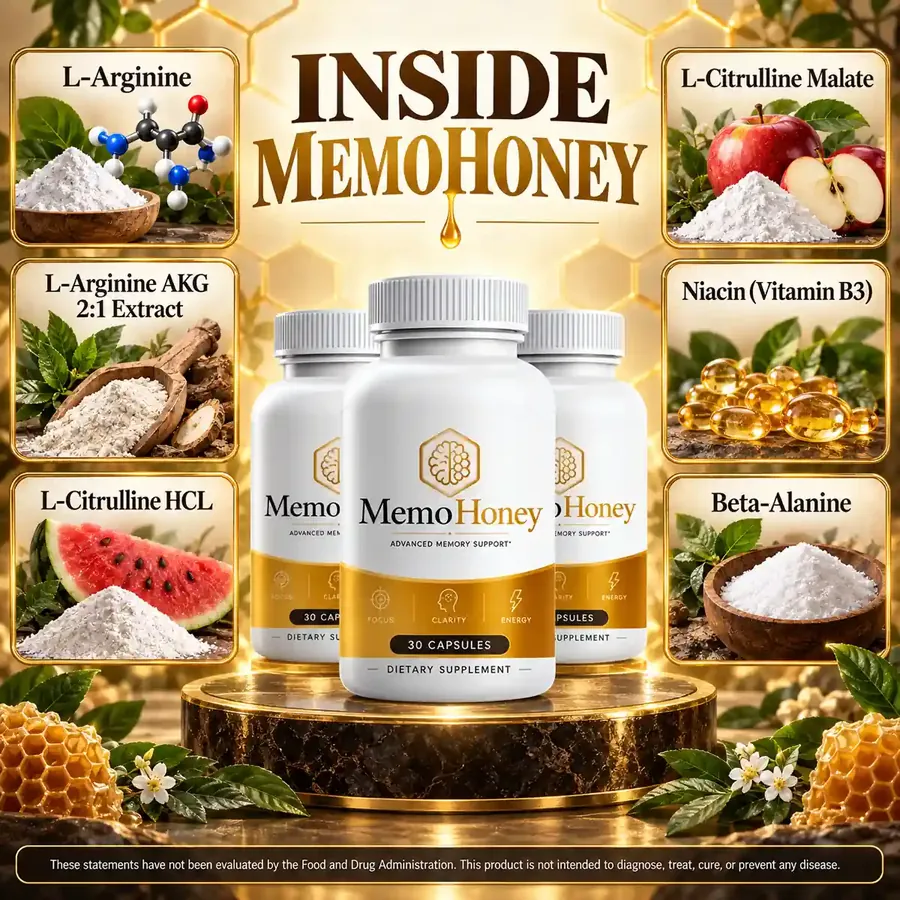
MemoHoney passes this check. Its panel prints all seven lines with their own amounts and has no blend. See the full Supplement Facts transcription.
Checks 3 and 4
Do the doses match the studies?
Find the studied dose for each ingredient and what it was studied for. Then compare.
| Ingredient | MemoHoney | Studied dose | Studied for |
|---|---|---|---|
| L-arginine, two forms | 400 mg | 2-20 g a day (NIH ODS, Exercise supplements) | Exercise; heart, blood pressure and blood-flow conditions. No memory use listed (Mayo Clinic, L-arginine) |
| L-citrulline, two forms | 200 mg | 3-8 g (NIH ODS, Exercise supplements) | Exercise; weak support |
| Beta-alanine | 40 mg | 1.6-6.4 g a day (NIH ODS, Exercise supplements) | High-intensity exercise; mixed results |
| Niacin | 7.5 mg NE | Daily Value 16 mg NE (NIH ODS, Niacin) | A needed nutrient; memory only in severe deficiency |
| Calcium | 18 mg | 1.5% of the Daily Value | Trace amount |
One capsule gives about one-fifth of the lowest arginine dose studied, one-fifteenth of the lowest citrulline dose and one-fortieth of the lowest beta-alanine dose. Memory studies of these amino acids are mostly early work or done in animals.
Check 5
What do FDA and FTC rules mean for memory supplements?
The FDA does not approve supplements before sale. The FTC requires real evidence for health claims.
No approval step
The FDA has no authority to approve supplements before they are sold (FDA, Supplement Q&A). An "FDA registered facility" badge means a registration, not an approval (FDA, Approval myths).
Claims need evidence
Health claims need competent and reliable scientific evidence, and testimonials cannot replace it (FTC, Health claims).
A legal line
In 2019 the FTC and FDA warned sellers over Alzheimer's and dementia claims: "a cure-all often turns out to be a cure-nothing" (FTC, Alzheimer's claims letters).
Look for the standard statement: not intended to diagnose, treat, cure or prevent any disease. MemoHoney's label carries it behind the asterisk on "Advanced Memory Support".
Ready to try MemoHoney?From $49 a bottle on 6 bottles · 60-day money-back window · free U.S. shipping on 3+
Order nowCheck 6
Red flags in memory supplement ads
Walk away from an ad that leans on any of these.
Borrowed fame
Fake celebrity ads exist for similarly named memory products. No celebrity, including Bill Gates, is linked to MemoHoney in any way.
"Honey recipe" hooks
Some ads sell a story about a honey drink. Ask what the bottle actually contains. MemoHoney's label lists no honey.
Alzheimer's promises
Never trust a supplement that claims to treat dementia. Regulators have warned sellers about exactly that (FTC, Alzheimer's claims letters).
Fake articles
Pages styled like a news site, with an unnamed doctor in a lab coat, are ads.
Countdowns
Timers, "only today" pricing and vanishing stock push you past the label.
Too good to check
The FTC bans fake and AI-written reviews (FTC, Fake reviews rule), and warns that fakes are hard to spot (FTC, Online reviews).
Check 7
Lookalike names and websites
Similar names are not the same product. Match the label every time.
Medihoney is an unrelated wound-care honey brand. MemoPryl, MemoCept, MemoGenesis, Memopezil and MemoBoost are different products with their own labels. Other domains, such as memohoneyy.com and memohoneyofficial.com, use the MemoHoney name; we cannot vouch for them.
Before you order any memory product, compare the Supplement Facts panel on the site with the bottle you receive. Read where to buy MemoHoney.
Check 8
Check interactions before you buy
Show the panel to your pharmacist along with your medicine list.
Ingredients that affect blood flow can also affect medicines. L-arginine, for example, interacts with blood pressure drugs, nitrates, sildenafil, blood thinners, diabetes drugs and potassium-sparing water pills (Mayo Clinic, L-arginine). Tell your provider about every supplement you take (NCCIH, Supplements for cognition).
MemoHoney's caution asks people with a known medical condition to consult a physician, but names no drugs. The side effects and interactions table fills that gap.
Fair score
How does MemoHoney score on this checklist?
Strong on disclosure and a simple routine. Weak on dose, evidence and outside testing.
| Check | Result | Why |
|---|---|---|
| Every amount printed | Pass | Seven lines, each with its own amount; no blend |
| Doses vs studies | Fail | A small fraction of studied amounts |
| Studied for memory | Fail | Amino acids studied for exercise and blood flow; niacin only if deficient |
| Claims | Partial | FDA statement printed; sales-page brain claims have no study behind them |
| Testing proof | Missing | Badges name no lab, certifier or facility; "doctor formulated" names no doctor |
| Ad red flags | Partial | No celebrity; the name suggests honey the formula lacks |
| Seller details | Pass | Distributor named; little public information beyond the label |
| Interaction warning | Partial | General caution; no drugs named |
Also fair to count: one small capsule a day, a 60-day money-back window, and a $158 minimum order on the smallest pack.
FAQ
Choosing a memory supplement FAQ
Do memory supplements actually work?
None has direct evidence of preventing dementia, according to NCCIH (NCCIH, Supplements for cognition). Ginkgo, omega-3s, vitamin E, curcumin and B vitamins have not clearly helped. Results for any single product depend on its ingredients and doses, so read the label.
What is a proprietary blend on a supplement label?
A proprietary blend lists several ingredients under one total weight without the amount of each. You cannot compare any single ingredient with research. MemoHoney has no blend; every line has its own amount.
Are memory supplements FDA approved?
No. Dietary supplements reach store shelves without any FDA approval step (FDA, Supplement Q&A). A facility registration is not an approval either (FDA, Approval myths). Treat any claim of FDA approval on a supplement as a red flag.
How can I tell if supplement reviews are fake?
Watch for bursts of similar reviews, check the reviewers' history, and don't assume you can spot every fake (FTC, Online reviews). The FTC now bans fake and AI-generated reviews and testimonials (FTC, Fake reviews rule).
Are celebrity-endorsed memory supplements real?
Be very skeptical. Fake celebrity ads circulate for similarly named memory products. MemoHoney has no celebrity endorser or developer. Read how to spot fake celebrity ads.
Is MemoCept or MemoGenesis the same as MemoHoney?
No. MemoCept, MemoGenesis, MemoPryl, Memopezil and MemoBoost are different products with different labels. Medihoney is an unrelated wound-care honey brand. Match the Supplement Facts panel to be sure.
What dose should a memory supplement have?
There is no single right dose. Compare each ingredient with the amounts used in research. For MemoHoney's amino acids, studies used grams a day (NIH ODS, Exercise supplements), while one capsule holds milligrams.
Who wrote this
Written and reviewed by
Plain-language pages built from the label, the sales page and linked public health sources.
Last updated . Read our editorial standards and how we check reviews. This website is run by a U.S. retail desk that sells MemoHoney, not by the maker (the label says distributed by Instituto Experience, Ogden, UT). We earn money when you buy through our order links.
Keep reading
More about MemoHoney
Supplement Facts
The MemoHoney label, line by line: amounts, % Daily Value, the odd double forms and what the bottle does not say.
Read moreTesting & quality
What the MemoHoney label proves about quality, what no document backs up yet, and how to read the brand's badges.
Read more
Fake celebrity memory ads
The warning signs of fake celebrity memory ads, what the FTC requires, and where to report one.
Read moreLicensed U.S. retail desk for MemoHoney
Ready to try MemoHoney?
Three packs on the sales page: 2, 3 or 6 bottles. The 6-bottle pack costs the least per bottle and ships free in the U.S.
- Secure checkout
- 60-day window
- Ships from the U.S. with tracking