Guide
Memory Loss: What Is Typical With Age and When to See a Doctor
Forgetting a name or a word now and then, and remembering it later, is a typical part of aging (NIA, Memory loss and forgetfulness). See a doctor when memory changes disrupt daily life, keep getting worse or worry the people around you. Some causes, such as low vitamin B12, medicines, depression or thyroid problems, are treatable (MedlinePlus, Memory loss) (NCCIH, Supplements for cognition). A supplement is not a substitute for that visit.
Written by the MemoHoney editorial teamUpdated
Start here
Is forgetfulness a normal part of aging?
Yes, some of it. Occasional slips are common. Changes that get in the way of daily life are not.
The National Institute on Aging says forgetting things now and then is a normal part of aging (NIA, Memory loss and forgetfulness). Misplacing your keys or blanking on a name, then recalling it later, fits that pattern.
Trouble with everyday tasks is different. Forgetting how to use your phone or how to get home may signal a more serious problem (MedlinePlus, Memory). Normal aging does not cause dramatic memory loss (MedlinePlus, Memory loss).
Between the two sits mild cognitive impairment (MCI): more memory problems than usual for your age, while daily life still mostly works (NIA, Memory loss and forgetfulness). A doctor can tell these apart. A checklist cannot.

Side by side
Typical forgetfulness vs warning signs of dementia
The Alzheimer's Association lists 10 warning signs, each with a typical age-related change for comparison.
| Warning sign | Typical change with age |
|---|---|
| Memory loss that disrupts daily life | Sometimes forgetting names or appointments, but remembering them later |
| Trouble planning or solving problems | Making an occasional mistake with bills |
| Trouble finishing familiar tasks | Now and then needing help with a new device setting |
| Confusion about time or place | Mixing up the day of the week, then figuring it out |
| Trouble with images and distances | Vision changes from cataracts |
| New problems with words | Sometimes losing a word |
| Misplacing things and being unable to retrace steps | Misplacing things, then retracing steps to find them |
| Poor judgment | A bad decision once in a while |
| Pulling away from work or friends | Sometimes feeling tired of social plans |
| Changes in mood or personality | Getting irritable when a routine is disrupted |
Sources: (Alzheimer's Association, 10 signs) (NIA, Memory loss and forgetfulness). One sign alone does not mean dementia, and a missing sign does not rule it out.
Act on it
When should you see a doctor about memory loss?
Book a visit when changes affect daily life, keep worsening or worry others. Call 911 for sudden changes.
Occasional slips
A lost word or a late bill, remembered later. Mention it at your next checkup.
A pattern
Any of the 10 warning signs, repeated questions, or family members noticing. The Alzheimer's Association helpline is 800.272.3900 (Alzheimer's Association, 10 signs).
Sudden change
Sudden confusion, trouble speaking, or weakness on one side can be a stroke (CDC, Stroke signs).
Worth checking
What treatable conditions can cause memory problems?
Several. That is the main reason to see a doctor instead of waiting.
| Possible cause | Why it matters | Source |
|---|---|---|
| Medicines or medicine reactions | Some drugs, or combinations, affect thinking | (MedlinePlus, Memory loss) (NCCIH, Supplements for cognition) |
| Low vitamin B1 or B12 | A blood test can find it | (MedlinePlus, Memory loss) |
| Depression | Can look like memory loss | (MedlinePlus, Memory loss) (NCCIH, Supplements for cognition) |
| Thyroid, liver or kidney problems | Can impair memory | (NCCIH, Supplements for cognition) |
| Alcohol | Heavy use harms memory | (MedlinePlus, Memory loss) |
| Stroke | Can cause memory loss, sometimes suddenly | (MedlinePlus, Memory loss) |
| Severe niacin deficiency (pellagra) | Causes memory loss, depression and fatigue | (NIH ODS, Niacin) |
Pellagra is rare. Extra niacin helps memory only in people who are truly short of it (NIH ODS, Niacin).
Before the visit
How do you prepare for a doctor visit about memory?
Bring examples, a full list of what you take, and someone who knows you well.
Write down examples
Note what happened, when, and how often. "Missed two bills in March" helps more than "I forget things."
List everything you take
Prescriptions, over-the-counter drugs and supplements, with doses. Bring the bottles if that is easier (NCCIH, Supplements for cognition).
Note sleep, mood and alcohol
Short sleep, low mood and drinking habits all matter to the doctor.
Bring someone along
A family member or friend often notices changes you miss.
Ask your questions
What could be causing this? Which tests do you suggest? When should we check again?

Ready to try MemoHoney?From $49 a bottle on 6 bottles · 60-day money-back window · free U.S. shipping on 3+
Order nowDaily habits
How do sleep and exercise fit into memory health?
Adults need 7 or more hours of sleep a night (CDC, Sleep) and 150 minutes of moderate activity a week (CDC, Activity).
- 7:30 am, 1 capsule
With 8 oz of water, 20-30 minutes before breakfast (label).
- Your other medicines
Keep their own schedule. Ask a pharmacist about blood pressure and heart medicines.
- Move every day
Adults need 150 minutes of moderate activity a week.
- Night, 7+ hours
Adults need 7 or more hours of sleep a night.
Timing comes from the label (before a meal) and the sales page (morning). Activity (CDC, Activity); sleep (CDC, Sleep).
These are general health targets, not memory treatments. Poor sleep is still worth raising with your doctor, along with snoring or daytime sleepiness.
Supplements
Where does a memory supplement like MemoHoney fit?
At most beside a doctor visit, never in place of one. MemoHoney treats nothing.
There is no direct evidence that any supplement prevents Alzheimer's or other dementias (NCCIH, Supplements for cognition). NCCIH advises against using supplements as a reason to put off a memory check.
MemoHoney is labeled for memory support, but its arginine, citrulline and beta-alanine were studied mainly for exercise and blood flow, at grams a day (NIH ODS, Exercise supplements). Read how to judge a memory supplement and the interactions table.
List every supplement, MemoHoney included. L-arginine interacts with blood pressure and heart medicines (Mayo Clinic, L-arginine).
Recap
Memory health checklist
- Occasional slips that you recall later: note them, mention them at a checkup.
- Changes that affect daily life or worry others: book a visit.
- Sudden confusion or one-sided weakness: call 911.
- Bring every medicine and supplement to the appointment.
The MemoHoney ingredients page shows each amount next to research doses.
FAQ
Memory changes FAQ
What is normal forgetfulness for my age?
Forgetting a name, an appointment or a word now and then, and remembering it later, is typical with age (Alzheimer's Association, 10 signs). Losing the ability to handle daily tasks, such as bills or getting home, is not (MedlinePlus, Memory).
When should I worry about memory loss?
Worry when memory changes disrupt daily life, keep getting worse, or concern family members. Those patterns call for a doctor visit (Alzheimer's Association, 10 signs). Sudden confusion or trouble speaking is different: call 911 (CDC, Stroke signs).
What is mild cognitive impairment?
Mild cognitive impairment means more memory problems than normal for your age, while daily life mostly still works (NIA, Memory loss and forgetfulness). A doctor diagnoses it and can watch for changes over time.
Can vitamin B12 deficiency cause memory loss?
Yes. MedlinePlus lists low vitamin B12 and B1 among the causes of memory loss, with alcohol, medicines, depression and stroke (MedlinePlus, Memory loss). A blood test can check B12. MemoHoney contains no B12.
Can a supplement replace a memory evaluation?
No. NCCIH says not to use supplements as a reason to postpone seeing a provider about memory loss (NCCIH, Supplements for cognition). Some causes are treatable, and a supplement cannot find them.
Does memory loss always mean dementia?
No. Alcohol, medicines, low B1 or B12, depression and stroke can all cause memory loss (MedlinePlus, Memory loss), and some of these are treatable. Normal aging does not cause dramatic memory loss, so a big change deserves a doctor visit.
Who can I call about memory concerns?
Start with your primary care doctor. The Alzheimer's Association runs a helpline at 800.272.3900 for questions about warning signs and next steps (Alzheimer's Association, 10 signs).
Who wrote this
Written and reviewed by
Plain-language pages built from the label, the sales page and linked public health sources.
Last updated . Read our editorial standards and how we check reviews. This website is run by a U.S. retail desk that sells MemoHoney, not by the maker (the label says distributed by Instituto Experience, Ogden, UT). We earn money when you buy through our order links.
Keep reading
More about MemoHoney

Choosing a memory supplement
An eight-step label checklist for any memory supplement, the ad red flags to skip, and how MemoHoney scores.
Read more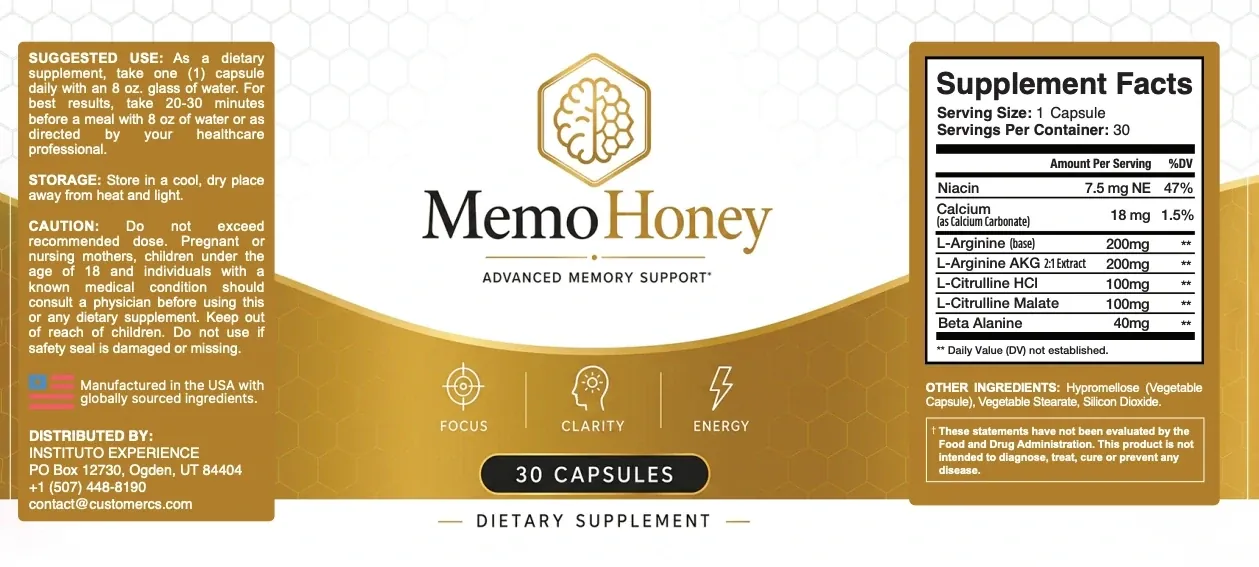
Side effects
Side effects for each MemoHoney ingredient, the drug interactions table, and the signs that mean stop and call a doctor.
Read more
Who it's for
Who might consider MemoHoney, who should ask a doctor first, and when memory changes need a visit instead.
Read moreLicensed U.S. retail desk for MemoHoney
Ready to try MemoHoney?
Three packs on the sales page: 2, 3 or 6 bottles. The 6-bottle pack costs the least per bottle and ships free in the U.S.
- Secure checkout
- 60-day window
- Ships from the U.S. with tracking