Guides
MemoHoney Guides and Articles: Where to Start
Two in-depth guides and three articles cover the questions people search most about MemoHoney and memory supplements. Worried about memory? Start with the memory health guide. Comparing products? Use the label checklist. Curious about the name, the ingredients or a celebrity ad? Pick the matching article. A short glossary explains NE, DV, AKG and the other label terms.
Written by the MemoHoney editorial teamUpdated
Start here
Which MemoHoney guide should you read first?
Find your situation in the left column and start with the reading on the right.
| Your situation | Read first | Why |
|---|---|---|
| You or a parent seem more forgetful | Memory health guide | Typical changes vs warning signs, and causes a doctor can treat |
| You are comparing memory supplements | Label-first checklist | Eight checks that work on any bottle |
| An ad made you think it contains honey | The honey article | What the label really lists |
| You saw a famous face in an ad | The fake-ads article | How the pattern works and how to check a seller |
| You want to know if the ingredients help memory | The research article | What studies of arginine, citrulline and beta-alanine looked at |
| You take heart, blood pressure or diabetes medicine | Side effects and interactions | L-arginine's interaction list, drug by drug |
| You want the exact label | Supplement Facts | Every line and amount, word for word |
In-depth guides
Two guides for memory and supplement decisions
Both are written for adults deciding what to do next, not for selling a pack.
Memory loss: what is typical and when to see a doctor
A side-by-side table of the 10 warning signs and the typical change for each, from the Alzheimer's Association (Alzheimer's Association, 10 signs). It lists treatable causes such as low B12, medicines, depression and thyroid problems, a five-step plan for the doctor visit, and the sleep and activity targets adults need.
How to choose a memory supplement
Eight label checks: printed amounts vs blends, doses vs studies, what each ingredient was studied for, FDA and FTC rules, ad red flags, lookalike names and drug interactions. MemoHoney gets the same test, with passes and fails shown.
From the blog
Three articles on what people search about MemoHoney
Each one answers a single question in depth, with sources linked.
Does MemoHoney contain honey?
No. The article walks through the label line by line, explains why the honeycomb art is branding, and separates MemoHoney from Medihoney and honey-recipe ads.
Nitric oxide ingredients and memory
What arginine, citrulline and beta-alanine were studied for, at what doses, and why exercise results do not carry over to memory.
Fake celebrity memory ads
Fake news pages, borrowed faces and similar product names. How to check a seller and where to report an ad.
Ingredient pages
Where to read about each MemoHoney ingredient
Four ingredient pages cover six of the seven label lines. Calcium is covered on the main ingredients page.
L-arginine
Base and AKG forms. Studied for heart and blood-flow conditions; not for memory (Mayo Clinic, L-arginine).
L-citrulline
HCl and malate forms. Studied for exercise at grams per dose (NIH ODS, Exercise supplements).
Beta-alanine
Sold for high-intensity exercise. Tingling starts near 800 mg (NIH ODS, Exercise supplements).
Glossary
MemoHoney glossary: label and health terms
Short definitions for the words on the label and across the guides.
| Nitric oxide | A gas the body makes from arginine. It signals blood vessels to relax. Taking arginine does not reliably raise it (NIH ODS, Exercise supplements). |
|---|---|
| NE (niacin equivalents) | The unit labels use for niacin. It also counts niacin the body makes from the amino acid tryptophan (NIH ODS, Niacin). |
| DV (Daily Value) | A reference amount used on labels. "47% DV" for niacin means 7.5 of the 16 mg NE Daily Value. |
| AKG | Alpha-ketoglutarate. In "L-Arginine AKG 2:1", arginine is bound to AKG, so part of the 200 mg is not arginine. |
| Malate and HCl | Partner compounds bound to citrulline: malic acid and hydrochloride. They change the weight, not the ingredient. |
| Hypromellose | The plant-based capsule shell. The label calls it a vegetable capsule. |
| Vegetable stearate, silicon dioxide | Other ingredients commonly used to help capsule powder flow. No amounts are printed. |
| Proprietary blend | Several ingredients under one total weight. MemoHoney has none. |
| Paresthesia | Harmless pins-and-needles tingling from large single doses of beta-alanine (NIH ODS, Exercise supplements). |
| Flushing | Warm, red, itchy skin from larger doses of nicotinic acid, one form of niacin (NIH ODS, Niacin). |
| MCI (mild cognitive impairment) | More memory problems than normal for one's age (NIA, Memory loss and forgetfulness). |
| Potassium-sparing diuretic | A water pill that keeps potassium in the body. It interacts with L-arginine (Mayo Clinic, L-arginine). |
| MedWatch | The FDA program for reporting a reaction to a supplement or drug. |
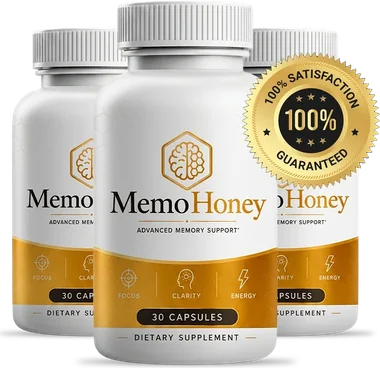
Ready to try MemoHoney?From $49 a bottle on 6 bottles · 60-day money-back window · free U.S. shipping on 3+
Order nowThe look
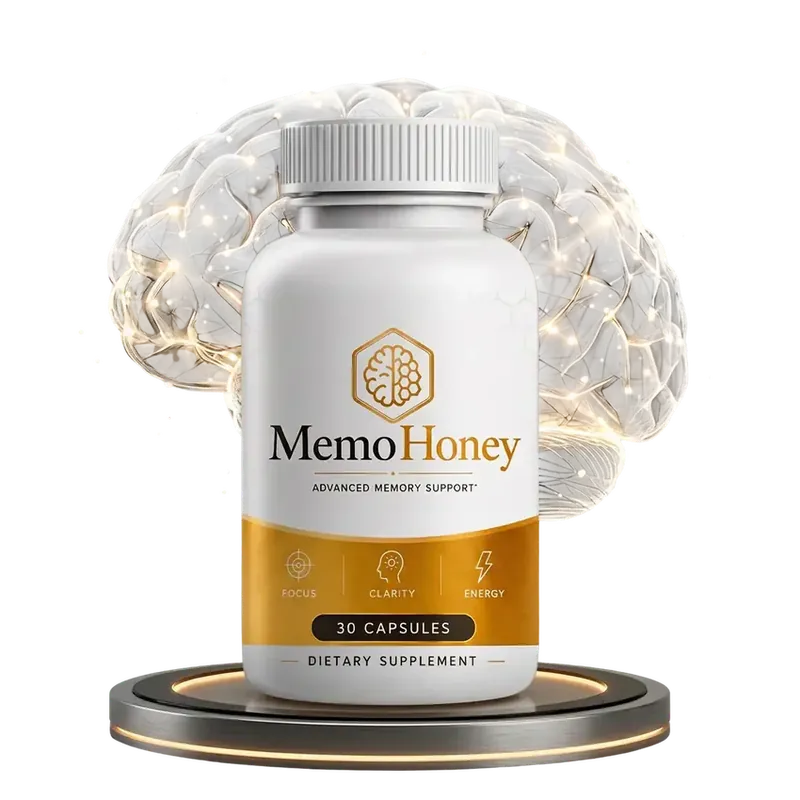
Why does MemoHoney's artwork show honey and a brain?
It is branding. The capsule contains amino acids, niacin and calcium, and no honey.
The honeycomb mark, the gold label band and the glowing brain are design choices by the brand. None of them is an ingredient or a test result.
That matters because honey-themed memory ads exist in this category. When artwork and label disagree, trust the label. The guides above always start from the Supplement Facts panel, and the ingredients page shows each line next to studied doses.
Our method
How are these guides written and checked?
From the label first, then public health sources, with every source linked.
Each guide starts from the MemoHoney label and the sales page, then checks claims against NIH, Mayo Clinic, NIA, MedlinePlus, CDC, FDA and FTC pages. A medical reviewer has not been named yet; the review box at the bottom stays blank until one is.
- No star ratings, review counts or customer quotes until they are verified.
- No disease claims, and no celebrity endorsements.
- When we fix an error, the updated date changes too.
The publisher, Memohoneynow, sells MemoHoney as a licensed U.S. retail desk. It did not make the product, and it earns money when people buy through its order links. See our editorial standards.
Before any guide
If memory changes worry you, start with a doctor
Changes that affect daily life deserve a medical visit, because some causes are treatable (NCCIH, Supplements for cognition). Sudden confusion, trouble speaking or weakness on one side can be a stroke: call 911 (CDC, Stroke signs).
FAQ
MemoHoney guides FAQ
Where should I start if I am new to MemoHoney?
Start with the Supplement Facts page, which lists all seven label lines and amounts. Then read the honey article and the label checklist. If memory changes are the reason you are looking, read the memory health guide first.
What do NE and DV mean on the MemoHoney label?
NE stands for niacin equivalents, the unit used for niacin. It includes niacin the body makes from tryptophan (NIH ODS, Niacin). DV is the Daily Value, so 7.5 mg NE per capsule is 47% of the 16 mg niacin DV.
What does L-arginine AKG 2:1 mean?
It is arginine bound to alpha-ketoglutarate, usually written AKG. Because part of the weight is AKG, the 200 mg line holds somewhat less than 200 mg of arginine. The label does not give the exact split.
What is nitric oxide, and why is it linked to MemoHoney?
Nitric oxide is a gas the body makes from arginine to relax blood vessels. MemoHoney's arginine and citrulline are nitric oxide ingredients. Exercise research found that arginine, even at grams a day, usually left nitric oxide and blood flow unchanged (NIH ODS, Exercise supplements).
Are the MemoHoney guides medical advice?
No. They explain the label and summarize public health sources so you can talk with your doctor or pharmacist. Decisions about memory symptoms or medicines belong with a clinician who knows your history.
How often are the MemoHoney guides updated?
They are checked when the label, the sales page or a cited source changes. Each fix also changes the updated date. This version reflects October 13, 2026.
Who writes the MemoHoney guides?
The MemoHoney editorial team at Memohoneynow, a licensed U.S. retail desk for MemoHoney, writes them. Memohoneynow sells MemoHoney but does not make it. A medical reviewer's name will appear in the review box once one is confirmed.
Who wrote this
Written and reviewed by
Plain-language pages built from the label, the sales page and linked public health sources.
Last updated . Read our editorial standards and how we check reviews. This website is run by a U.S. retail desk that sells MemoHoney, not by the maker (the label says distributed by Instituto Experience, Ogden, UT). We earn money when you buy through our order links.
Keep reading
More about MemoHoney
Ingredients
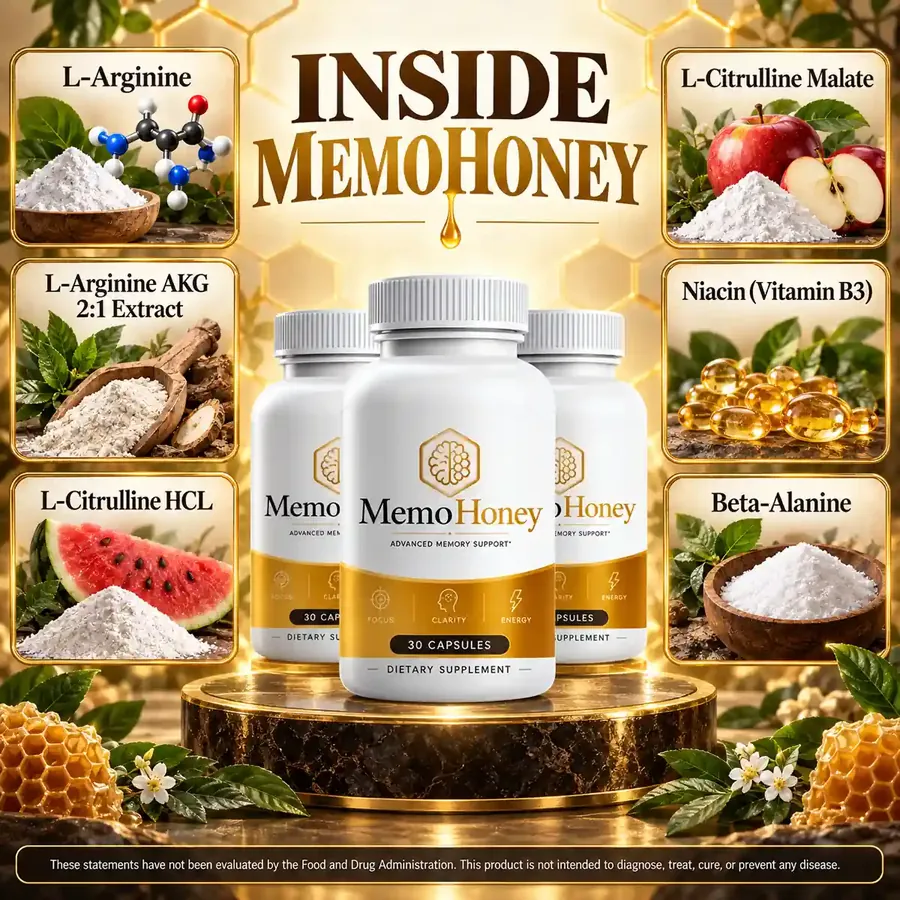
All seven MemoHoney label lines with their amounts, what each is studied for, and how the doses compare with research.
Read more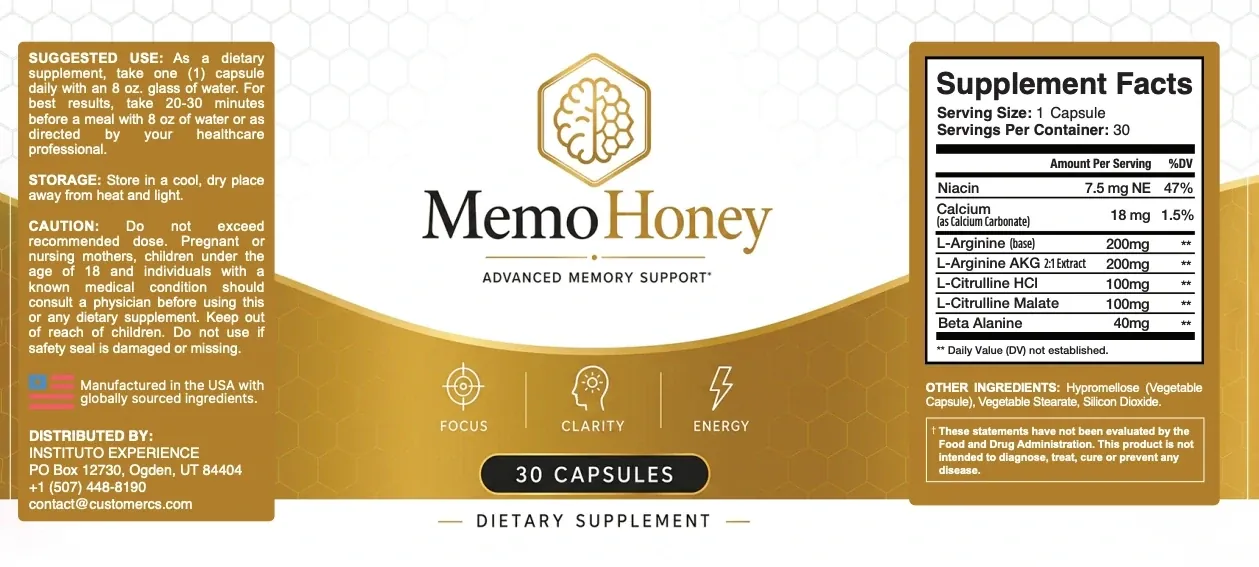
Side effects
Side effects for each MemoHoney ingredient, the drug interactions table, and the signs that mean stop and call a doctor.
Read moreSupplement Facts
The MemoHoney label, line by line: amounts, % Daily Value, the odd double forms and what the bottle does not say.
Read moreLicensed U.S. retail desk for MemoHoney
Ready to try MemoHoney?
Three packs on the sales page: 2, 3 or 6 bottles. The 6-bottle pack costs the least per bottle and ships free in the U.S.
- Secure checkout
- 60-day window
- Ships from the U.S. with tracking