Ingredient profile
Niacin (Vitamin B3) in MemoHoney: 7.5 mg NE Explained
Each MemoHoney capsule lists 7.5 mg NE of niacin, which is 47% of the Daily Value. Adults need 14 to 16 mg NE a day, and the upper limit from supplements is 35 mg (NIH ODS, Niacin). The label does not say which form of niacin it uses. Niacin helps memory only in people who are seriously short of it.
Written by the MemoHoney editorial teamUpdated
The basics
What is niacin, and why is it in MemoHoney?
Niacin is vitamin B3, a nutrient everyone needs from food. It is the first line on the MemoHoney Supplement Facts panel.
Your body uses niacin to turn food into energy and to keep skin, nerves and the gut working. Meat, poultry, fish, nuts and enriched grains all supply it. The label does not explain why niacin was added to a capsule sold for memory, so we do not guess.
| Label name | Niacin |
|---|---|
| Scientific name | Vitamin B3 (form not stated) |
| What it is | Vitamin |
| Position in the list | 1 of 7 (every amount is printed per capsule) |
| Per capsule | 7.5 mg NE (47% DV) |
| Amount used in research | Adults need 14-16 mg NE a day; upper limit for supplements 35 mg |
| Strength of evidence | Needed nutrient; no memory data |
| Traditional or marketed use | B vitamin; about half the Daily Value |
| Main caution | Flushing starts around 30-50 mg of nicotinic acid; count niacin in other products. |
Reading the label
What does 7.5 mg NE mean on the MemoHoney label?
NE stands for niacin equivalents. It is the unit nutrition labels use for vitamin B3.
The body gets niacin in two ways. It absorbs niacin from food and pills, and it also makes some from tryptophan, an amino acid in protein foods. Niacin equivalents count both, so needs and Daily Values are written in mg NE (NIH ODS, Niacin).
For a capsule, 1 mg NE is simply 1 mg of niacin. So MemoHoney gives 7.5 mg of niacin a day. The Daily Value is 16 mg, and 7.5 divided by 16 is about 47%, which matches the label.
| Measure | Amount | One capsule covers |
|---|---|---|
| MemoHoney, 1 capsule | 7.5 mg NE | Label amount |
| Daily Value | 16 mg NE | About 47% |
| Adult men need | 16 mg NE a day | About half |
| Adult women need | 14 mg NE a day | A little more than half |
| Upper limit from supplements and fortified foods | 35 mg a day | About one-fifth |
By the numbers
Niacin in MemoHoney at a glance
Niacin and memory
Does niacin help memory?
Only when someone is truly low in it. Severe niacin deficiency, called pellagra, causes memory loss along with other problems.
The NIH Office of Dietary Supplements lists depression, apathy, headache, tiredness and loss of memory among the signs of pellagra (NIH ODS, Niacin). Getting enough niacin corrects that kind of memory loss. That is the full extent of the link.
If your diet already covers your needs, extra niacin has no shown memory effect.
A shortage of a B vitamin is only one possible cause. Others, like medicine side effects, thyroid problems or depression, are treatable too (NCCIH, Supplements for cognition). Read the memory health guide for when to see a doctor.

Niacin flush
Will the niacin in MemoHoney cause flushing?
Unlikely at 7.5 mg. A niacin flush is linked to 30 to 50 mg or more of the nicotinic acid form (NIH ODS, Niacin).
A niacin flush is warm, red, itchy or tingly skin on the face, arms and chest. It comes from one form of niacin, nicotinic acid. The other common form, nicotinamide (also called niacinamide), does not cause it (NIH ODS, Niacin).
The MemoHoney label just says "Niacin". It does not say which form is inside. Even if it is nicotinic acid, one capsule holds a quarter or less of the amount tied to flushing.
- Label form: not stated
- Per capsule: 7.5 mg NE
- Flushing range for nicotinic acid: 30 to 50 mg or more
- Nicotinamide: not linked to flushing
Stacking it with a high-dose niacin product is what raises the odds.
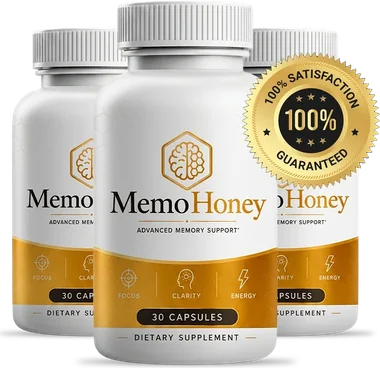
Ready to try MemoHoney?From $49 a bottle on 6 bottles · 60-day money-back window · free U.S. shipping on 3+
Order nowAdding it up
How much niacin is too much? Counting other products
The 35 mg upper limit covers niacin from supplements and fortified foods together, not from each product on its own.
Multivitamins, B-complex pills and some energy drinks also add niacin. Each lists its own amount, and the amounts add up.
Gather your labels
Pull out every supplement, vitamin pack and energy drink you use in a normal day.
Find the niacin line
Write down each niacin amount in mg or mg NE. Count MemoHoney as 7.5 mg.
Compare with 35 mg
If the total goes past 35 mg a day, show the list to a pharmacist before adding anything new.
| Product type | Does it often contain niacin? | What to check |
|---|---|---|
| Multivitamin | Yes, in most | The niacin line and its % DV |
| B-complex or "energy" vitamin | Yes, often higher | Whether the form is nicotinic acid |
| Energy drink or shot | Often | Amount per can or bottle, and how many you drink |
| Prescription niacin | Yes, at high doses | Ask your doctor before adding any supplement |
Medicines
Niacin and medicines: TB drugs and blood sugar
Two medicine notes from the NIH apply to niacin in general. Neither is printed on the MemoHoney label.
First, isoniazid and pyrazinamide, two tuberculosis drugs, can interfere with how the body uses niacin (NIH ODS, Niacin). People on these drugs sometimes need their niacin status watched by their doctor.
Second, large doses of nicotinic acid can raise blood sugar (NIH ODS, Niacin). That matters most for people with diabetes who take high-dose niacin. The 7.5 mg in one MemoHoney capsule is far from those doses, but it still counts toward your daily total.
Show the MemoHoney label to your doctor or pharmacist first. Keep taking your prescribed medicine while they review it, and never stop or change a dose on your own.
MemoHoney also contains L-arginine, which has its own medicine cautions. See the side effects and interactions page.
Our take
Is the niacin in MemoHoney a plus?
It is a sensible, modest dose of a real nutrient. It is not a memory treatment, and the label leaves out one useful detail.
Points in its favor
- Amount printed clearly: 7.5 mg NE, 47% DV
- Well under the 35 mg upper limit
- Too small to cause flushing on its own
- Covers about half of an adult's daily need
Points against
- The niacin form is not stated
- Helps memory only if you are deficient
- Adds to niacin from multivitamins and drinks
- No study of niacin inside this formula
Other ingredients
Explore the other MemoHoney ingredients
Niacin is the vitamin in the formula. The rest are amino acids and a trace of calcium.
Compare it with all seven lines on the ingredients page. Then read about L-arginine, L-citrulline and beta-alanine, or see the Supplement Facts label.
FAQ
Niacin in MemoHoney: questions people ask
What does NE mean on a supplement label?
NE means niacin equivalents. It counts niacin you take in plus niacin your body makes from tryptophan, an amino acid in protein foods. In a capsule, 1 mg NE equals 1 mg of niacin, so MemoHoney's 7.5 mg NE is 7.5 mg of niacin (NIH ODS, Niacin).
Is 7.5 mg of niacin a lot?
No. It is 47% of the 16 mg Daily Value and about one-fifth of the 35 mg upper limit for supplements and fortified foods (NIH ODS, Niacin). Many multivitamins contain more. It becomes worth watching only when you add it to other niacin products.
Will MemoHoney cause a niacin flush?
Probably not. Flushing is tied to 30 to 50 mg or more of nicotinic acid, and one capsule has 7.5 mg NE (NIH ODS, Niacin). The label does not name the niacin form. If you also take a high-dose niacin product, flushing becomes more likely.
What form of niacin is in MemoHoney?
The label does not say. It lists only "Niacin 7.5 mg NE". The two common forms are nicotinic acid, which can cause flushing at higher doses, and nicotinamide, which does not.
Is niacin good for memory?
Only if you are deficient. Severe niacin shortage (pellagra) causes memory loss along with depression, headache and fatigue, and enough niacin corrects it (NIH ODS, Niacin). For people who already get enough from food, extra niacin has no shown memory benefit.
Can I take MemoHoney with a multivitamin?
Often yes, but add up the niacin first. Count 7.5 mg from MemoHoney plus the niacin in your multivitamin and any energy drinks. If the total passes 35 mg a day, ask a pharmacist before combining them (NIH ODS, Niacin).
Does niacin interact with any medications?
Yes, in general. The TB drugs isoniazid and pyrazinamide can interfere with niacin, and large nicotinic acid doses can raise blood sugar (NIH ODS, Niacin). If you take these medicines or diabetes medicine, show the MemoHoney label to your doctor first.
Who wrote this
Written and reviewed by
Plain-language pages built from the label, the sales page and linked public health sources.
Last updated . Read our editorial standards and how we check reviews. This website is run by a U.S. retail desk that sells MemoHoney, not by the maker (the label says distributed by Instituto Experience, Ogden, UT). We earn money when you buy through our order links.
Keep reading
More about MemoHoney
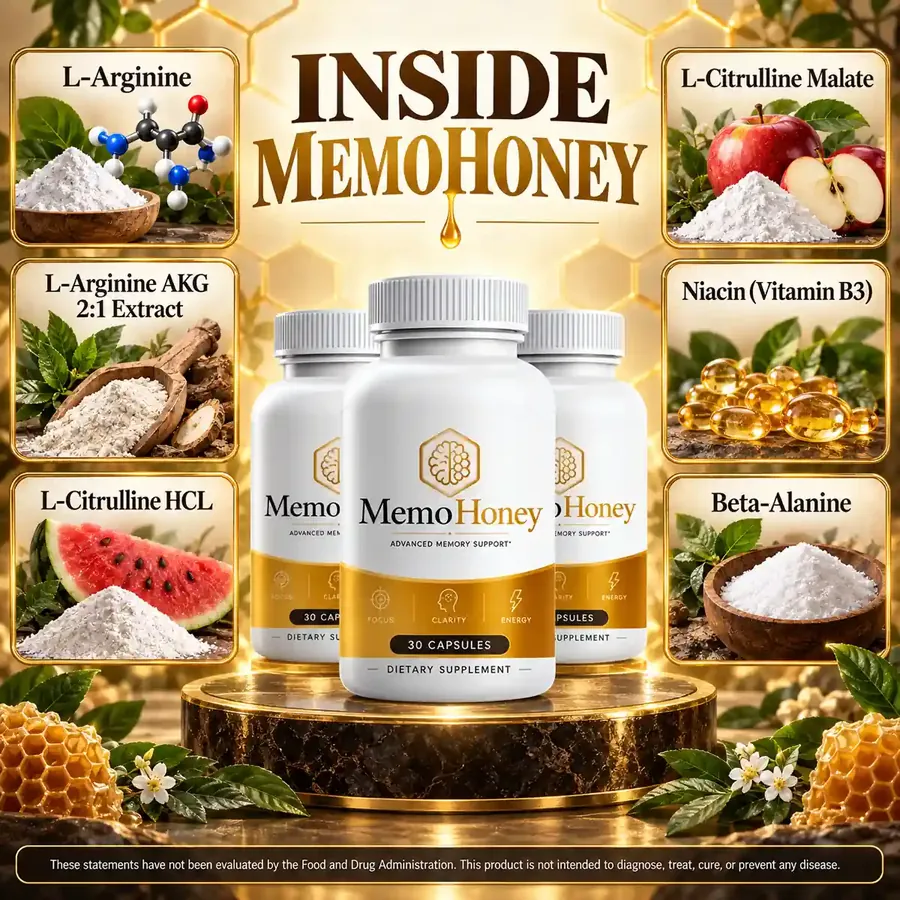
Ingredients
All seven MemoHoney label lines with their amounts, what each is studied for, and how the doses compare with research.
Read more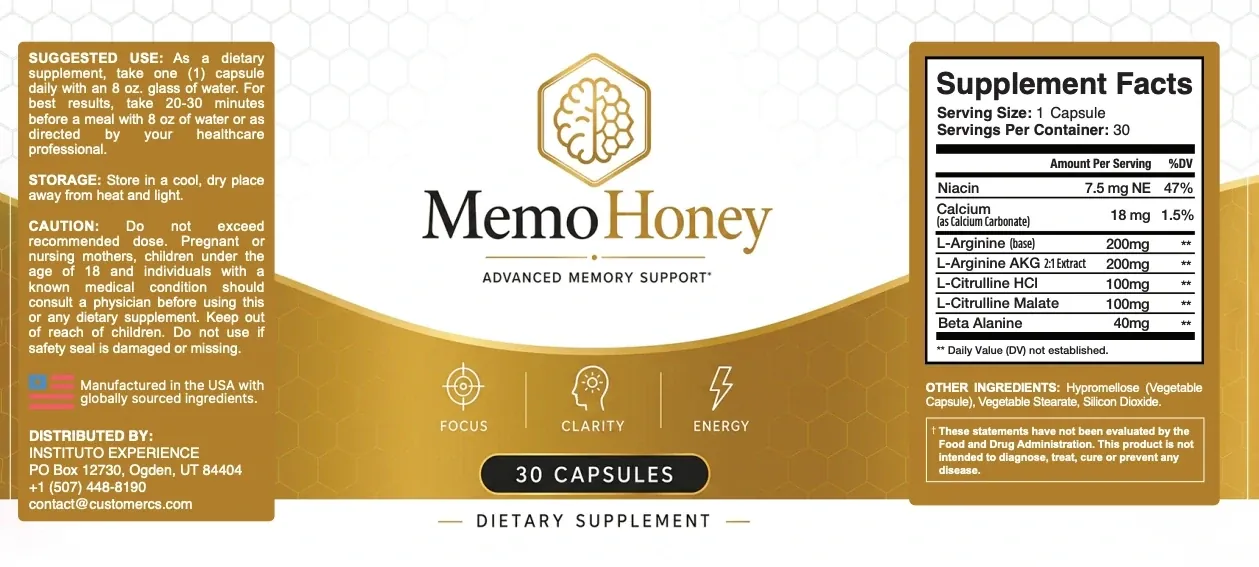
Side effects
Side effects for each MemoHoney ingredient, the drug interactions table, and the signs that mean stop and call a doctor.
Read moreSupplement Facts
The MemoHoney label, line by line: amounts, % Daily Value, the odd double forms and what the bottle does not say.
Read moreLicensed U.S. retail desk for MemoHoney
Ready to try MemoHoney?
Three packs on the sales page: 2, 3 or 6 bottles. The 6-bottle pack costs the least per bottle and ships free in the U.S.
- Secure checkout
- 60-day window
- Ships from the U.S. with tracking