Blog
Arginine, Citrulline and Beta-Alanine for Memory: What the Research Shows
Very little that applies to memory. The NIH Office of Dietary Supplements reviewed arginine, citrulline and beta-alanine as exercise aids at gram doses, and its summary says nothing about memory (NIH ODS, Exercise supplements). Even 2-20 g of arginine a day typically did not raise nitric oxide or blood flow. MemoHoney's capsule holds milligrams, a small fraction of those amounts.
Written by the MemoHoney editorial teamUpdated · 9 min read

The basics
What is nitric oxide, and what does it do in the body?
Nitric oxide is a small gas molecule your body makes on its own. Its best-known job is telling blood vessel walls to relax, which lets the vessels widen.
The body builds nitric oxide from the amino acid arginine. Citrulline matters because the body turns it into arginine. That is why both are sold as "nitric oxide boosters" for workouts.
Beta-alanine is not a nitric oxide ingredient. It is sold for short bursts of hard exercise.
Nitric oxide also acts as a messenger in the brain. But a molecule having a role there is not the same as a pill helping memory.
The formula
Why does a memory supplement contain nitric oxide ingredients?
Because the sales page builds its pitch on blood flow. It says MemoHoney can "increase cerebral blood flow" and support memory and focus (MemoHoney sales page).
| Label line | Per capsule | Mainly studied for | Memory use in our sources |
|---|---|---|---|
| L-arginine (base + AKG) | 200 mg + 200 mg | Exercise, blood pressure, circulation (NIH ODS, Exercise supplements) (Mayo Clinic, L-arginine) | None listed |
| L-citrulline (HCl + malate) | 100 mg + 100 mg | Exercise (NIH ODS, Exercise supplements) | None listed |
| Beta-alanine | 40 mg | High-intensity exercise (NIH ODS, Exercise supplements) | None listed |
See the L-arginine, L-citrulline and beta-alanine pages.
L-arginine
Does L-arginine raise nitric oxide or blood flow?
Not reliably, even at large doses. The NIH Office of Dietary Supplements reports that 2-20 g of arginine a day had little to no effect on exercise performance and typically no effect on nitric oxide levels or blood flow (NIH ODS, Exercise supplements).
On safety, up to 9 g a day for days or weeks was well tolerated. At 9-30 g a day, people had diarrhea, nausea and slightly lower blood pressure.
So the step the sales pitch depends on did not show up in human studies. The fact sheet never mentions memory.
The other two
What did studies find for L-citrulline and beta-alanine?
L-citrulline
One study gave 41 weightlifters 8 g of citrulline malate; they did more reps with less soreness, but 6 had stomach discomfort. Another used 3 g, or 9 g over a day, and people did worse than on placebo in a treadmill test. ODS says the research does not provide strong support (NIH ODS, Exercise supplements).
Beta-alanine
Studied at 1.6-6.4 g a day and appears safe for up to 8 weeks, with mixed results for high-intensity exercise. Doses of 800 mg or more at once can cause a harmless tingling of the skin for 60-90 minutes (NIH ODS, Exercise supplements).
Neither summary mentions memory. Research on these amino acids and memory is mostly in animals or early.
Mayo Clinic
Is L-arginine used for memory, according to Mayo Clinic?
No. Mayo Clinic lists evidence for angina, high blood pressure, preeclampsia, erectile dysfunction with a physical cause and peripheral artery disease. Memory and thinking are not on the list (Mayo Clinic, L-arginine).
Taken by mouth it is generally safe, though nausea, cramps, diarrhea and bloating can occur.
L-arginine is not recommended after a recent heart attack. It may lower blood pressure too far with blood pressure drugs, nitrates or sildenafil, and Mayo also lists blood thinners, diabetes medicine and potassium-sparing water pills (Mayo Clinic, L-arginine). Keep taking your prescribed medicine, and never stop or change a dose on your own.
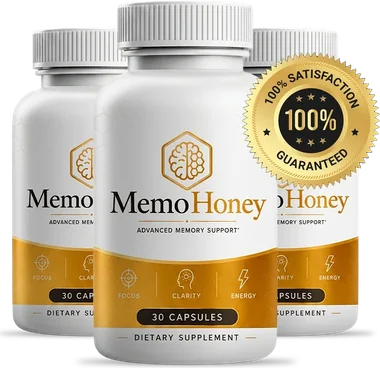
Ready to try MemoHoney?From $49 a bottle on 6 bottles · 60-day money-back window · free U.S. shipping on 3+
Order nowDose check
How far are MemoHoney's amounts from the studied doses?
Far. Each bar compares one capsule with the low end of studied doses.
One capsule holds about one-fifth of the lowest arginine dose studied, one-fifteenth of the lowest citrulline dose and one-fortieth of the lowest beta-alanine dose (NIH ODS, Exercise supplements). To be fair, MemoHoney prints every amount, which makes this check possible.
The claim
Does MemoHoney raise blood flow to the brain?
No study shows it. "Blood flow to the brain" is an idea from the sales page, not a finding from the sources behind it (MemoHoney sales page).
The pitch needs three links: more nitric oxide, more brain blood flow, better memory. The first failed in human studies at far larger doses (NIH ODS, Exercise supplements). No source here tests the others.
NCCIH says direct evidence is lacking: no supplement has been shown to prevent Alzheimer's or other dementias. Ginkgo, omega-3s and B vitamins have not clearly helped (NCCIH, Supplements for cognition).
Bottom line
What should you take away from the nitric oxide research?
These are workout ingredients with a memory label, studied at doses many times higher than MemoHoney's.
Don't let any supplement delay a visit about memory loss. Depression, medicine reactions and thyroid, liver or kidney problems can all affect memory, and they can be treated (NCCIH, Supplements for cognition). See the memory health guide.
Sources
- Dietary Supplements for Exercise and Athletic Performance: Fact Sheet for Health Professionals. NIH Office of Dietary Supplements, 2026.Arginine 2-20 g a day had little to no effect on performance and typically no effect on nitric oxide or blood flow; up to 9 g a day for weeks is well tolerated; 9-30 g causes stomach upset and slightly lower blood pressure. Citrulline studied at 3-8 g; support is weak; safety over months not well assessed. Beta-alanine 1.6-6.4 g a day appears safe for up to 8 weeks; 800 mg or more in one dose can cause harmless tingling for 60-90 minutes.
- L-arginine. Mayo Clinic, 2026.Studied for angina, high blood pressure, erectile dysfunction and peripheral artery disease (no memory use listed). Generally safe orally; nausea, cramps, diarrhea, bloating, gout, allergy, worse asthma. Not recommended after a recent heart attack. Interactions: blood pressure drugs, nitrates, sildenafil, blood thinners, diabetes drugs, potassium-sparing diuretics, isoproterenol.
- 7 Things To Know About Dietary Supplements for Cognitive Function, Dementia, and Alzheimer's Disease. National Center for Complementary and Integrative Health, 2026.Direct evidence that supplements prevent Alzheimer's or other dementias is lacking; don't use them as a reason to postpone seeing a provider about memory loss; treatable conditions such as depression, medicine reactions, thyroid, liver or kidney problems can impair memory.
FAQ
Nitric oxide ingredients and memory: common questions
What does nitric oxide do to the brain?
Nitric oxide is a messenger molecule in many tissues, the brain included, and it helps blood vessels relax. That role does not mean a supplement can change memory. The NIH fact sheet on arginine, citrulline and beta-alanine reports no memory findings (NIH ODS, Exercise supplements).
Can nitric oxide supplements help brain fog?
No good evidence says so. Arginine at 2-20 g a day typically did not even raise nitric oxide in studies (NIH ODS, Exercise supplements). Brain fog has many causes, including sleep, medicines, mood and thyroid problems, so a checkup is the better first step (NCCIH, Supplements for cognition).
Do nitric oxide boosters help memory?
Our sources show no memory benefit. NIH reviewed them only as exercise aids (NIH ODS, Exercise supplements), and Mayo Clinic lists no memory use for L-arginine (Mayo Clinic, L-arginine). Research on these amino acids and memory is mostly in animals or early, and none tested MemoHoney.
How much L-arginine did studies use?
Exercise studies used 2-20 g a day (NIH ODS, Exercise supplements). One MemoHoney capsule holds 400 mg of arginine ingredients, and part of the AKG form is alpha-ketoglutarate, so the true arginine content is somewhat lower. That is about one-fifth of the smallest studied dose.
Is beta-alanine a nitric oxide booster?
No. Beta-alanine does not work through nitric oxide; it is sold for short, hard exercise. Studies used 1.6-6.4 g a day (NIH ODS, Exercise supplements). MemoHoney has 40 mg per capsule, far below the 800 mg single dose linked to skin tingling.
Is L-citrulline safe to take every day?
Short term, it seems so. ODS reports no adverse effects from up to 6 g a day for 4 weeks in people who were not athletes, but safety over months has not been well studied (NIH ODS, Exercise supplements). MemoHoney's 200 mg a day is far below those amounts.
Who wrote this
Written and reviewed by
Plain-language pages built from the label, the sales page and linked public health sources.
Last updated . Read our editorial standards and how we check reviews. This website is run by a U.S. retail desk that sells MemoHoney, not by the maker (the label says distributed by Instituto Experience, Ogden, UT). We earn money when you buy through our order links.
Keep reading
More about MemoHoney

L-arginine
Both arginine lines in MemoHoney: nitric oxide basics, Mayo Clinic's list of uses, study doses and who should ask first.
Read more
How it works
The nitric oxide idea behind MemoHoney, what NIH research found about it, and the questions no study has answered yet.
Read more
Memory health guide
Typical forgetfulness vs warning signs, treatable causes of memory loss, and how to prepare for a doctor visit.
Read moreLicensed U.S. retail desk for MemoHoney
Ready to try MemoHoney?
Three packs on the sales page: 2, 3 or 6 bottles. The 6-bottle pack costs the least per bottle and ships free in the U.S.
- Secure checkout
- 60-day window
- Ships from the U.S. with tracking